On this page (10 sections)
Quick answer
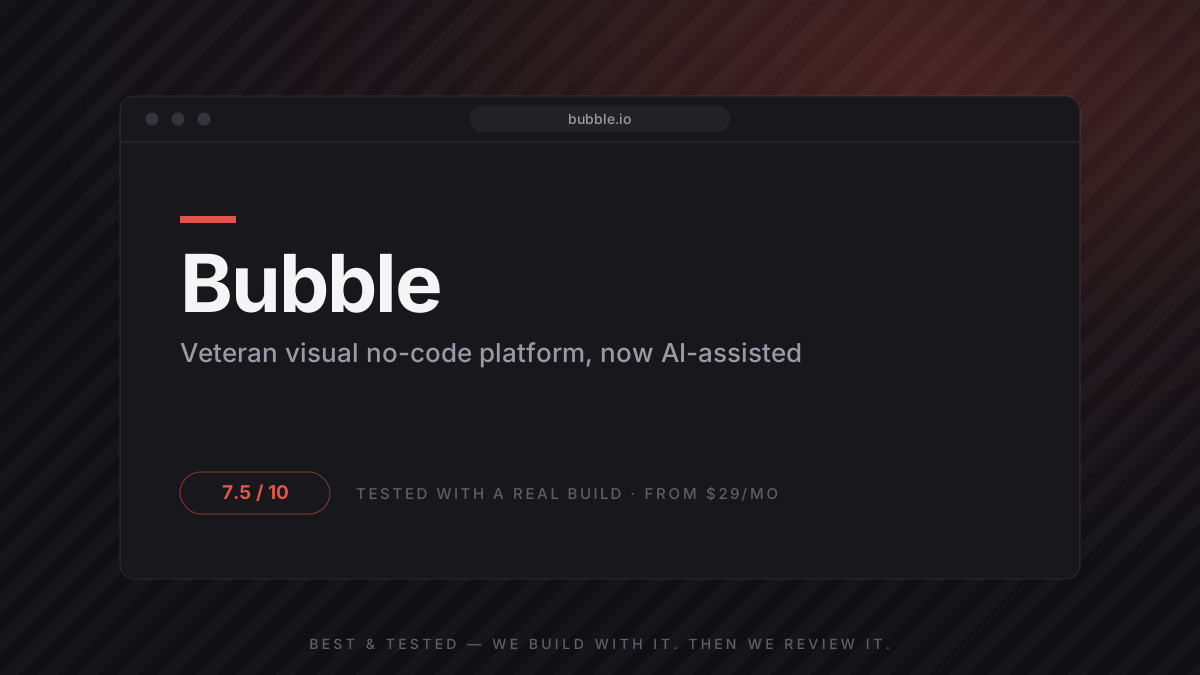
Is Bubble worth it in 2026? Yes, if you want the deepest no-code platform on the market and you plan to stay on it. Bubble builds real full-stack apps — auth, database, payments, dashboards — with more custom logic than any AI code builder, and a 14-year plugin ecosystem behind it. The catch is a steep learning curve, a Workload-Unit bill that spikes with traffic, and no source-code export. If owning your code matters, look at Lovable instead.
The most capable visual app builder in 2026 — as long as you accept that Bubble owns the app, not you.
Best for teams building data-heavy internal tools and B2B SaaS who will commit to the platform long-term.
What impressed me
- Deepest no-code logic of any builder — real workflows, not toys
- 6,000+ plugins and thousands of templates after 14 years
- Built-in auth, database and Stripe with no service to wire
- Bubble AI Agent scaffolds a working MVP in minutes
What frustrated me
- No source-code export — leaving means rebuilding from scratch
- Workload-Unit pricing spikes unpredictably with traffic
- Steep learning curve despite the no-code label
- Slower than native code; wrong pick for high-traffic apps
The Bottom Line
The most capable visual app builder in 2026 — as long as you accept that Bubble owns the app, not you.
Key takeaways
- Bubble builds more custom backend logic without code than any AI builder we track — the invoicing brief is comfortably in range.
- Paid starts at $29/mo (web, annual) with 175K Workload Units; the real cost lives in WU overage as you scale.
- The Bubble AI Agent (launched Oct 2025) scaffolds pages, a database and workflows from a prompt — but you still build the app by hand from there.
- There is no code export. This is the single biggest reason the score isn't higher, and the reason to weigh Lovable if portability matters.
- Choose Bubble for depth and a long-term home; choose Lovable to own the code, or Glide for the simplest possible build.
Bubble at a glance
| Best for | Data-heavy internal tools & B2B SaaS on a long-term platform |
| Pricing | Free tier · Paid from $29/mo (web, annual) + Workload Units |
| Generates | Full visual app: UI, database, workflows, auth — no code shown |
| Code ownership | None — visual only, no source export (platform lock-in) |
| Deploy | 1-click to a bubbleapps.io subdomain or custom domain |
| Our score | 7.5/10 — scoring methodology |
What is Bubble, exactly?
Bubble is the veteran of no-code. It launched in 2012 — a decade before anyone said “vibe coding” — and it is a full visual development platform, not a code assistant. You design the interface on a drag-and-drop canvas, model your data as “things” with fields, and wire behaviour as event-driven workflows. All of it runs on Bubble’s AWS-backed hosting, and none of it requires you to write a line of syntax.
In 2026 Bubble wears an AI layer on top of that foundation. The Bubble AI Agent, released in October 2025, turns a plain-English prompt into a working scaffold — pages, a database structure and workflows — that you then keep editing by hand in the visual editor. It understands your existing app: your data types, your design system, your architecture. But the important thing to understand up front is what it is not. Bubble never hands you React or SQL. Everything you make lives inside Bubble, and everything stays inside Bubble.
That is the whole decision in one sentence. The other builders in the 2026 wave — Lovable, Bolt, v0, Replit — generate real code you can export. Bubble keeps you in its editor in exchange for far more depth. No-code power versus owning the code: that trade-off runs through this entire review.
How Bubble handles the invoicing brief
The brief we hold every builder to is the one we’d hand a freelance developer: a working freelancer invoicing app — user login, a client list, an invoice builder with VAT handling, Stripe checkout, and a revenue dashboard. Here is exactly how Bubble handles each piece.
Auth is the easy part: Bubble ships user accounts, password reset and social login (Google included) out of the box, so there is no third-party service to wire up. The database is native and visual — you model Clients, Invoices and Line Items as data types with fields, with no SQL and no separate Postgres to provision. The data layer is Bubble’s strongest foundation — and its most punishing if you model it badly early, because a weak initial schema often forces a rebuild later.
The invoice builder and VAT handling are where Bubble’s workflow engine earns its reputation. Conditional logic, calculated fields and repeating groups handle line items and tax maths without code — exactly the kind of custom backend logic that makes lighter AI builders stall. Stripe checkout runs through the official Stripe plugin or the API Connector; it works, but configuring it (and the webhooks for failed payments) is genuine setup, not a one-prompt affair. The revenue dashboard is a repeating group plus a charts plugin.
The honest bottom line: everything in the brief is achievable in Bubble, and the harder-logic parts land more comfortably than in most AI code builders. The cost is time. You build this app; the AI Agent only accelerates the scaffold.
Where Bubble shines
Depth no AI builder matches — 9/10
This is the reason Bubble still matters. The workflow engine handles conditionals, loops, scheduled tasks, API calls and multi-step backend logic visually. Privacy rules give you real row-level security. The API Connector plugs into virtually any external service. Where an AI code builder tends to produce logic that looks right and quietly fails, Bubble gives you an explicit, inspectable system you control step by step. Mini-verdict: nothing else in no-code goes this deep.
A 14-year ecosystem — 8/10
Maturity compounds. Bubble’s marketplace holds 6,000+ plugins and thousands of templates, backed by a large agency network and one of the most active forums in the category. Whatever you are trying to build, someone has usually built the hard part already. Mini-verdict: the ecosystem is a moat newer AI builders can’t replicate yet.
Where it stalls
The learning curve is real — 5/10
“No-code” sells the wrong expectation. You never write syntax, but you absolutely think like a developer: data types, conditionals, privacy rules and filtering logic can overwhelm non-technical teams. True beginners routinely underestimate the ramp. Mini-verdict: budget weeks, not an afternoon.
Workload Units make the bill unpredictable — 5/10
Every database query, every workflow and every API call consumes Workload Units. Plans include a monthly allowance — 175K on Starter, 250K on Growth — and overage past it is billed at a premium. Poorly optimised apps burn WU fast; there are documented cases of a single misconfiguration torching millions of units. Optimisation becomes a skill you are forced to learn just to keep the bill sane. Mini-verdict: the sticker price is the floor, not the ceiling.
No code export, and a hard ceiling at scale — 4/10
There is no source-code export. Leaving Bubble means rebuilding your app from scratch — a platform decision that quietly becomes an existential one once your IP is deeply embedded. That gap explains the split reputation: G2 sits around 4.4 from builders rating features, while Trustpilot hovers near 1.6, capturing billing and migration complaints. Performance compounds the concern — Bubble runs slower than native code and is a poor fit for high-traffic consumer apps or real-time-heavy products. Mini-verdict: commit only if you plan to stay.
Bubble vs Lovable: no-code vs owning the code
Same invoicing brief, two philosophies. Bubble keeps you in a visual editor with more logic depth; Lovable generates real React you can export and own. Here is the honest split:
| Bubble | Lovable | |
|---|---|---|
| Best for | Deep no-code apps, internal tools | Fast full-stack MVPs, non-devs |
| Approach | Visual editor, no code shown | Generates real React + Supabase |
| Custom backend logic | 9/10 | 6/10 |
| Ecosystem maturity | 6,000+ plugins since 2012 | Newer, smaller |
| Learning curve | Steep | Gentle |
| Code ownership | None — lock-in | Full GitHub export |
| Pricing (entry) | $29/mo + WU | $25/mo |
| Our score | 7.5 | 8.8 |
Bubble wins on raw capability and ecosystem. Lovable wins on the thing that turns a tool choice into a trap or an off-ramp — you can walk away with your code. For most people validating an idea, that portability is worth more than Bubble’s extra depth, which is why Lovable scores higher overall. For a team that has already decided Bubble is home, the depth is exactly the point.
Best Bubble alternatives
Lovable
The fastest idea-to-working-app builder we track, and it exports the full React repo to GitHub. Less backend depth than Bubble, zero lock-in.
Read the Lovable review →Glide
Spreadsheet-driven, genuinely easy, and great for mobile-friendly internal tools. Far less flexible than Bubble — that is the trade you make for the gentle curve.
Read the Glide review →Replit
Agent, hosting and a real code editor in one. Weaker UI polish than Bubble, but you write and own actual code and can learn as you go.
Read the Replit review →Pricing: what you actually pay
Bubble’s plans look simple and bill in two layers. The tier below is your base fee and Workload-Unit allowance; the second, invisible layer is overage once you exceed it. Prices are web-only on annual billing — monthly billing runs roughly 20% higher, and combined web + mobile bundles cost more again.
| Free | Starter | Growth | Team | |
|---|---|---|---|---|
| Price (annual) | $0 | $29/mo | $119/mo | $349/mo |
| Workload Units | 50K | 175K | 250K | 500K |
| Editors / storage | 1 / dev only | 1 / 10 GB | 2 / 100 GB | 5 / 1 TB |
| Realistically for | Learning only | A launched MVP | A growing SaaS | A small team |
| Watch out | No live deploy or custom domain | WU cap is low | Overage adds up fast | Still metered on WU |
The Free plan cannot deploy a live app, use a custom domain or remove Bubble branding — it is a sandbox, not a launch pad. Starter at $29/mo is the real entry point. Most serious apps land on Growth, and the number that actually decides your bill is not the tier at all — it is how efficiently your workflows are built.
Who should use Bubble — and who should skip it
✓ Get it if you are…
- Teams building data-heavy internal tools or B2B SaaS
- Founders who want deep custom logic without hiring devs
- Anyone who values a mature plugin and template ecosystem
- Projects that will genuinely live on Bubble long-term
✕ Skip it if you are…
- Developers who want to own and export their source code
- High-traffic consumer apps or real-time-heavy products
- Anyone who needs a predictable, flat monthly bill
- People expecting a finished app after one afternoon
How we evaluated Bubble
The Best & Tested protocol — same for every tool in this niche
- Scored on our fixed rubric — output quality 40%, workflow & capability 25%, pricing & value 20%, lock-in & portability 15% — so scores are directly comparable across our reviews
- Judged against the same freelancer-invoicing brief we hold every builder to
- Pricing and specs verified against Bubble official sources (2026)
- Failures and limitations noted, not hidden
- Reviews are re-scored whenever pricing, features or overall sentiment shift
Full protocol, weights and raw logs: How we test →
Final verdict: 7.5/10
Bubble is the most capable no-code platform you can buy in 2026. For a data-heavy internal tool or a B2B SaaS with real backend logic, nothing else in the category matches its depth, and its 14-year ecosystem quietly does half the work for you. The invoicing brief is comfortably within reach — more so than on most AI builders.
Two things hold the score at 7.5 rather than higher. The learning curve is steeper than the marketing admits, and the Workload-Unit model turns your monthly bill into a moving target. But the real ceiling is portability: there is no code export, so choosing Bubble means choosing to stay. Commit to that, and it is a genuinely powerful home for your app. If that lock-in gives you pause, that pause is the right instinct — and Lovable is where we’d send you next.
Frequently asked questions
Can Bubble build a real production app?
Does Bubble let you export the code?
How much does Bubble really cost?
Is Bubble AI as good as Lovable or Bolt?
Do I need to know how to code to use Bubble?
Bubble vs Lovable — which should I pick?
Sources & data
- Bubble official pricing page — bubble.io/pricing (accessed Jul 2026)
- No Code MBA — Bubble Pricing 2026 & AI App Builder review
- Goodspeed Studio — Bubble.io honest review 2026
- LOW/CODE — Bubble.io review & pricing plans (2026)
- G2 & Trustpilot aggregate user ratings (2026)
Review changelog
Jul 2026 — Initial review published